
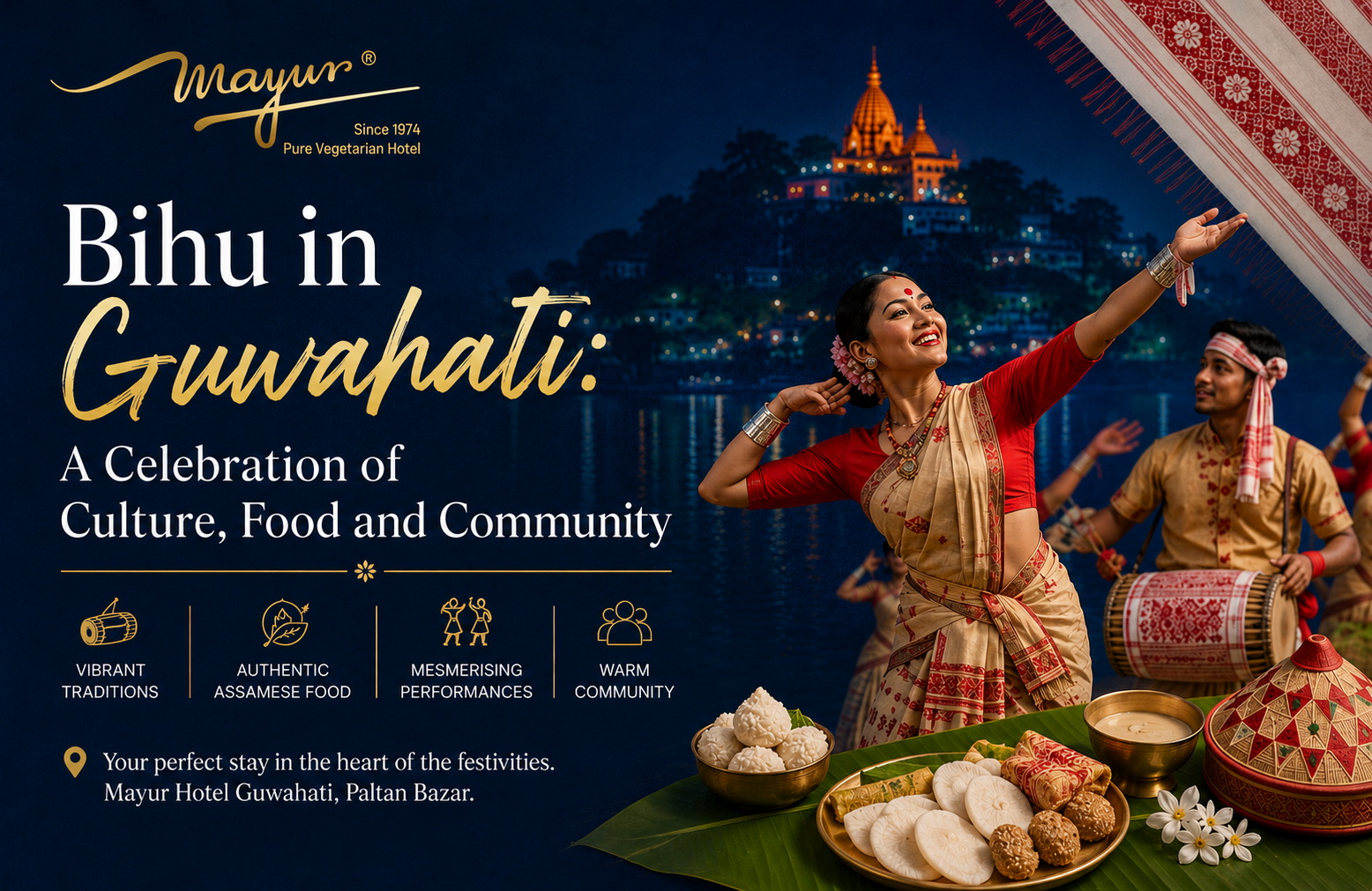
If you have never been to Guwahati during Bihu, it is difficult to describe what happens to the city in mid-April. The dhol starts before sunrise. By morning, the streets near Paltan Bazar fill with people in new clothes, mekhela chadors for the women, dhoti and kurta for the men. The smell of pitha being made in kitchens carries into the lane. And somewhere not far away, a group of young people is already dancing.
Bihu is the Assamese New Year. It is also a harvest festival, a spring celebration, a homecoming, and a week-long community gathering all at once. For the people of Assam, it is not just a festival. It is the festival. Everything else in the year is measured against it.
For travellers visiting Guwahati, Bihu season is one of the best times to be here. The city is at its most alive, the food is at its most festive, and the cultural performances you see, if you get to the right venues are extraordinary. Mayur Hotel Guwahati is in Paltan Bazar, which is close to several of the city's main Bihu events. Rooms book out fast in April. If you are planning to come, this is the guide to read first.
What Bihu Actually Is
The word Rongali comes from rong, meaning joy. That is a good starting point. But Bihu is not simple joy the way a party is. It is something older and more layered.
It began as an agricultural festival. The people of Assam, a rice-growing civilization shaped by the Ahom kingdom, marked the sowing season each year with rituals, communal feasts, and dancing. Goru Bihu, the first day of the seven, is dedicated to cattle. Farmers bathe their cows and oxen, apply turmeric and oil, and offer prayers of gratitude for their role in the fields. This is not symbolic. For rural Assam, cattle are still part of daily survival, and Goru Bihu is a genuine act of thanksgiving.
The second day, Manuh Bihu, is for people. New clothes. Visits to elders. The exchange of gamosa, a hand-woven white cotton cloth with red borders that is the most recognizable symbol of Assamese identity. You give a gamosa to someone you respect. You wear one when you perform. It appears everywhere during Bihu week and carries a weight of cultural meaning that is hard to explain to someone who has not grown up with it.
Then comes the dancing. The Bihu dance is energetic, physical, and joyful in a way that is distinct from classical Indian dance forms. Performers move in groups. The dhol drives the rhythm and the pepa, a wind instrument made from buffalo horn, carries the melody. In 2023, over 11,000 dancers performed together at Sarusajai Stadium in Guwahati, setting a Guinness World Record. It is that kind of festival.
The Three Bihus: Which One to Visit For
Rongali Bihu (April): Come For the Culture
This is the grand one. Spring festival, Assamese New Year, seven days of dance and music. Guwahati hosts the Bihu Mela at Sarusajai Stadium through the last two weeks of April, with hundreds of troupes competing in Bihu dance and hundreds of thousands of visitors attending over the fortnight. This is the best Bihu to visit for first-time travellers.
Kati Bihu (October): The Quiet One
Kati Bihu, also called Kongali Bihu, is a much more subdued affair. It falls in October when the crops are still growing and the barns are relatively empty. Families light earthen lamps in the fields to ward off insects and protect the young rice. There is no dancing and no feasting. If you visit Guwahati in October for the atmosphere of the festival, you will find something more reflective and intimate than the spring celebration.
Bhogali Bihu (January): Come For the Food
Bhogali Bihu, also called Magh Bihu, marks the end of the harvest in January. The barns are full. The community comes together for meji bonfires lit at dawn, and the cooking in the days before is extraordinary. Pithas and larus prepared in bulk, rice beer shared among neighbours, massive community meals. If food is your primary reason for travelling to Guwahati, Bhogali Bihu in January is the one to plan around.
The Food of Bihu
Food is not a side note at Bihu. It is one of the central acts of the festival. Families spend days before the celebration preparing dishes that are specific to this time of year and appear almost nowhere else.
Jolpan
The traditional Bihu breakfast. Chira (flattened rice) served with curd and jaggery, or with coconut and banana. It is light, naturally sweet, and eaten in the morning before the day's celebrations begin. Simple food made with careful ingredients.
Pitha
Rice cakes, the definitive Bihu food. Til Pitha is made by rolling roasted sesame and jaggery inside a thin rice crepe and grilling it over a low flame. Narikolor Pitha uses grated coconut. Sunga Pitha is cooked inside a bamboo tube over a fire. Each type takes time and skill to make properly, and the making itself is part of the celebration — families cook together, the kitchen becomes a gathering place, and the smell announces the festival to the whole neighbourhood.
Laru
Narikolor Laru is a coconut and jaggery ball, rolled by hand and set firm. Til Laru uses sesame. Both are made in large batches during Bihu week and shared with visitors, neighbours, and family who drop by. You will find them at food stalls across Guwahati during the festival and at the markets around Sarusajai Stadium during the Bihu Mela.
Khar
Not exclusively a Bihu dish but very much an Assamese one. Khar is made using the alkaline ash of dried banana skin or the dried skin of sun-dried Kola bor (a local variety of banana), dissolved in water and strained, then used as a base for cooking raw papaya or other vegetables. The result is a dish with a subtle, slightly bitter flavour that is unlike anything else in Indian cooking.
Where to Experience Bihu in Guwahati
Sarusajai Stadium: The Big Stage
The Bihu Mela at Sarusajai Stadium is the flagship event. It typically runs through the last two weeks of April and is free to attend. Hundreds of Bihu dance troupes from across Assam compete on stage through the evening and into the night. The scale is enormous. Tens of thousands of people attend on peak evenings. Go early to find a good spot and plan to stay for at least two or three performances. The energy builds as the night goes on.
Srimanta Sankardev Kalakshetra: The Curated Version
For something more structured, the Kalakshetra cultural complex hosts Bihu performances through April in a venue that gives you context alongside the dance. The complex's permanent museums on Assamese arts and traditions make it the right place to understand what you are watching before you watch it. Good for families and first-time visitors to Guwahati.
Neighbourhood Bihutoli: The Real Version
The most genuine Bihu experience in Guwahati is not at the stadium. It is at the neighbourhood bihutoli, the local open-air festival grounds set up by community associations in every part of the city. Paltan Bazar, where Mayur Hotel Guwahati is located, and Fancy Bazar both have active neighbourhood celebrations. These are smaller, less polished, and far more intimate than the stadium events. You will see the same dances performed by people for their own community rather than for a competition, which changes the feeling completely.
Brahmaputra Riverfront: The Evening Setting
During Bihu week, the riverfront comes alive in the evenings with food stalls, music, and informal performances. The combination of the wide river, the April light, and the festival atmosphere makes it one of the better places to simply sit and take in Guwahati at its most celebratory. The Rooftop Restaurant at Mayur Hotel also has views over the city if you prefer to watch the evening unfold from above.
Practical Notes for Bihu Visitors
Book Your Room Early
April is one of the fastest-selling months in Guwahati. Mayur Hotel Guwahati is in Paltan Bazar, within easy reach of both the Sarusajai Stadium events and the neighbourhood bihutoli celebrations. Our Jr. Suite and Double Executive rooms are the popular choices for couples and solo travellers. Families coming together for Bihu will find the Family Villa and Family Deluxe rooms give everyone enough space. We are a pure vegetarian hotel, which makes us a natural fit for Bihu travellers observing traditional practices during the festival.
What to Wear
New clothes are part of Bihu. If you want to join in rather than just observe, wearing something new and traditional is the right instinct. For women, a mekhela chador in silk or cotton is the Assamese dress you will see everywhere. For men, a dhoti and kurta or a simple kurta with a gamosa draped over the shoulder is appropriate. You can find both in the fabric shops and markets of Paltan Bazar and Fancy Bazar before the festival starts.
The Gamosa
If someone offers you a gamosa during Bihu, accept it with both hands. It is one of the warmest gestures of welcome in Assamese culture. The white cotton cloth with its red woven borders is given to guests, to elders, to performers, and to people you want to honour. Carrying one back from Guwahati is a better souvenir than most things sold in tourist shops.
Getting Around During Bihu Week
The city is busy. Sarusajai Stadium is about 6 km from Paltan Bazar and easily reached by auto-rickshaw or cab. On peak evenings, traffic around the stadium slows considerably — leave earlier than you think you need to, and consider walking the last stretch from wherever the cab drops you. The neighbourhood bihutoli events are within walking distance of the hotel.
Early Morning on Bihu Day
Goru Bihu on April 14 starts before sunrise. If you are an early riser, the city at 5 AM on this day has a very particular quality: quiet and purposeful, with families already moving toward their rituals. The 24-hour Pastry Corner in the hotel lobby is open for those heading out early.
Bihu in Guwahati is the kind of experience that is hard to forget. The city opens up during this week in a way it does not at any other time of year. If you have been thinking about visiting Assam, this is when to come.
To book a room at Mayur Hotel Guwahati for Bihu 2026, WhatsApp us directly or call 8100 21 21 21. April rooms fill up weeks in advance and we recommend booking as early as you can.


